Let us take you on a journey of pure passion.
Every group we host in Spain has a flamenco experience included, and we cannot recommend it enough. We recommend this experience to all of our guests that we host in Spain.
If you’ve never seen a Flamenco show before, expect something very different from a typical dance performance. It’s not just entertainment; it’s an emotional experience.
Flamenco comes from Andalusia, in Southern Spain and reflects the history and lives of the people who lived there, particularly the Romani people (often called gypsies), who faced difficult social conditions, poverty, and injustice. For many of them, singing became a way to release pain, frustration, joy, and hope.
Flamenco began as something very simple and very personal. It was mainly singing and rhythm, performed alone. It was not originally a stage art with dancers and guitars. It was created by ordinary people who sang while living their everyday lives.
Farm workers sang while harvesting and ploughing the fields. Miners sang as they walked to and from the mines. Blacksmiths sang while working at the forge. In taverns, people sang to lift the mood or to share their feelings with others. Women sang while working at home or during family celebrations. Flamenco was not planned or performed for an audience, it was a natural way of expressing emotions.
At its heart, Flamenco begins in a moment of strong feeling. When someone feels something deeply, they sing it. It is emotional, personal, and sometimes rebellious. Through singing, people could express sorrow, anger, love, or celebration, and in doing so, they found a kind of freedom.
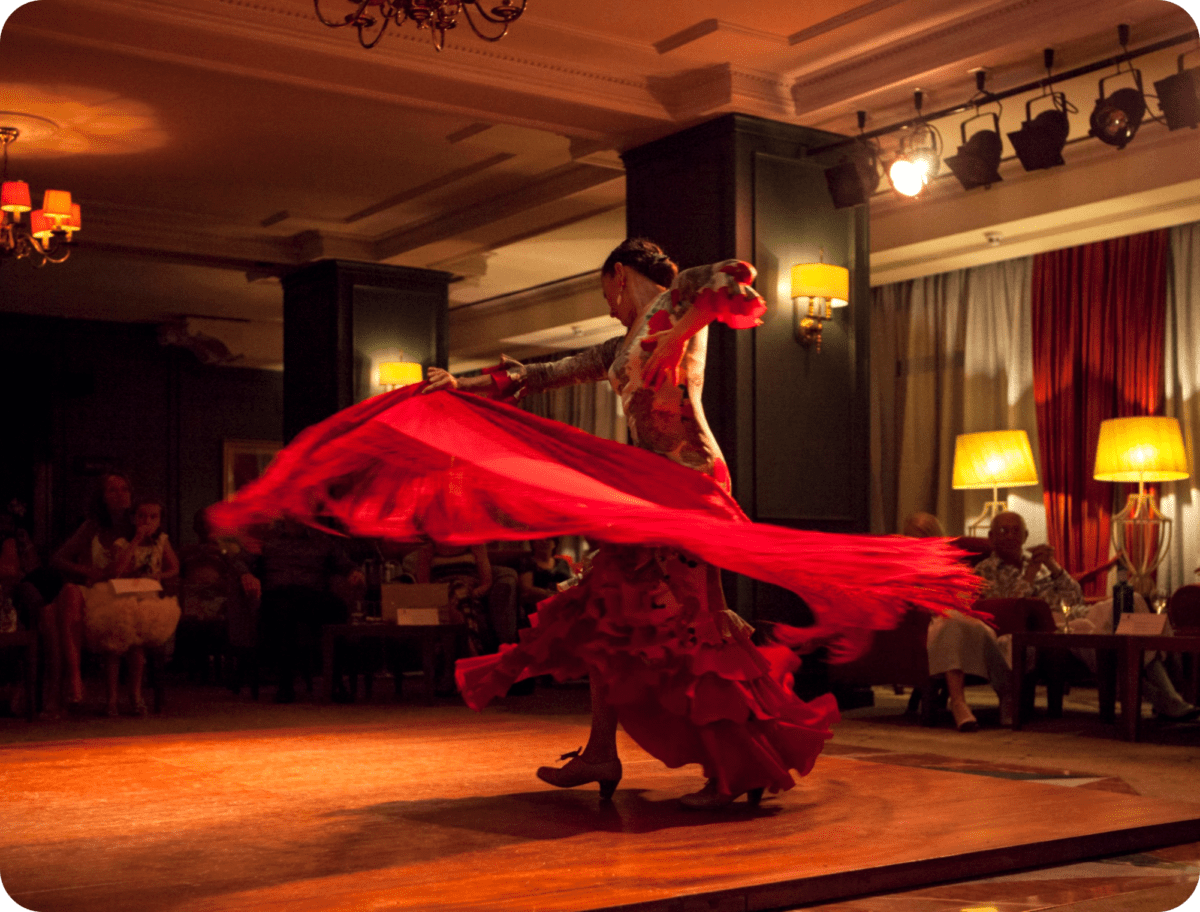
When you watch a Flamenco performance, you’re not just seeing a dance, you’re witnessing a powerful emotional conversation between music, movement, and rhythm.
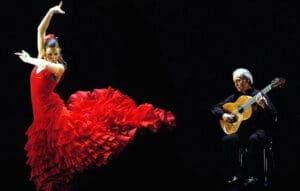
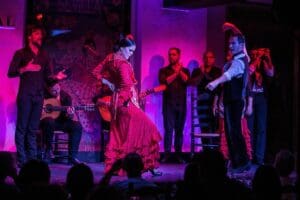
A traditional Flamenco show usually includes three main elements:
- The singer (cante) – The singing is raw, intense, and deeply emotional. Even if you don’t understand Spanish, you can feel the emotion in the voice. Sorrow, longing, joy, defiance.
- The guitarist (toque) – The guitar provides rhythm and melody. It can sound delicate and lyrical one moment, then fast and percussive the next.
- The dancer (baile) – The dancer expresses the music through strong footwork, dramatic posture, and precise hand and arm movements.
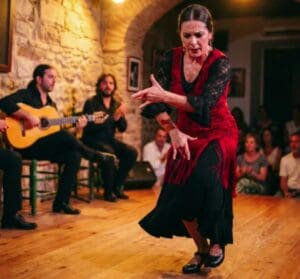
The atmosphere is intense and intimate, with when you travel with Golf & Tours, you will experience the authentic Flamenco, not the touristy version. The performances will take place in a small, dark venue, where you’re close to the performers. You’ll hear shouts of “¡Olé!” during the show, which that’s a traditional way of encouraging the artists. The rhythms (called compás) can be complex and hypnotic. The footwork can be incredibly fast and powerful, almost like percussion. The expressions of the dancer, singer and guitarist are serious and concentrated, not “smiley” like some other dances.
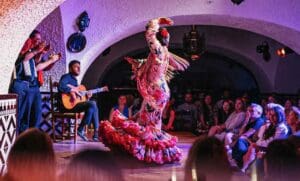
Don’t expect big group choreography or flashy special effects. Flamenco is about feeling. The best way to experience Flamenco is simply to relax and let yourself feel it. You don’t need to understand the language, the emotion, rhythm, and energy speak for themselves.